Hourly Rate Attorneys vs. Flat-Rate Attorneys for Divorce and Family Law

When you’re facing a divorce, one of the first decisions you’ll make is choosing between an hourly vs flat rate attorney. You’ve probably seen advertisements promising flat-fee divorces for a single, affordable price. On the surface, it sounds appealing. Who wouldn’t want to know exactly what they’ll pay upfront? But as with most things in family law, the reality is far more complicated than the advertising suggests.

The billing structure your attorney uses doesn’t just affect your wallet. It fundamentally shapes the quality of representation you receive, the attention your case gets, and ultimately, the outcome of your divorce. Before you sign any fee agreement, you need to understand what you’re actually getting for your money and what you might be giving up in the process.

Understanding the Hourly vs Flat Rate Attorney Difference

What Is an Hourly-Rate Divorce Attorney?

An hourly-rate attorney completes your case from start to finish using the same hourly rate for all work throughout your divorce or custody matter. This billing structure allows for complete flexibility across every stage of your case. Whether your attorney is negotiating with opposing counsel, preparing for trial, conducting discovery, or simply communicating with you about strategy, they bill at their established hourly rate against your retainer. This model means your attorney can adapt their approach as your case evolves. If unexpected complications arise, your attorney has the time and financial flexibility to address them thoroughly. If your spouse becomes uncooperative or new financial information surfaces, your hourly-rate attorney can pivot their strategy without worrying about whether the work fits within a predetermined flat fee.

The hourly model also allows for ongoing, consistent communication. You’re not limited to a certain number of phone calls or emails. Some flat fee attorneys do not permit phone calls from clients at all, in order to reduce contact which will reduce contact and cost. As your case progresses, you have access to your attorney when you need guidance, reassurance, or strategic advice. This hands-on approach means you’re never left wondering what’s happening with your case or feeling like you’re being rushed through the process.

What Is a Flat-Fee Divorce Attorney?

A flat-fee attorney charges one set amount for a specific result. Sometimes this applies to the entire divorce, and other times it covers only certain portions of your case. The appeal is obvious: you know what you’ll pay upfront, and there are no surprises on your bill at the end of the month.

However, this billing structure is far less flexible than hourly billing. Because the fee is set in advance, the structure is usually designed around a specific scope and outcome. Hourly billing, by contrast, supports deeper case-by-case attention, ongoing communication, and the flexibility to adjust strategy as your divorce evolves.

When your attorney is working within a flat-fee structure, they’re financially incentivized to spend as little time as possible on your case. The more time they spend on your divorce, the less profitable your case becomes for them. This creates a tension between thoroughness and efficiency that doesn’t exist in hourly billing. While a flat-fee arrangement might cost less upfront, it often means reduced attention to detail, less strategic thinking, and a more cookie-cutter approach to your unique circumstances. In an hourly representation structure, you retain the ability to streamline portions of your case, but you are not locked into that from the beginning if you need or choose other options throughout your case.

The Business Model Behind Flat-Fee Divorce

Flat-fee divorce has exploded in popularity, but not because it’s better for clients. It’s become popular because it’s an extremely effective business model for law firms focused on volume over quality. These firms operate on the same principle as fast food restaurants: process as many customers as possible, as quickly as possible, with as little customization as possible. To make flat-fee pricing profitable, attorneys must carry enormous caseloads that make meaningful individual attention nearly impossible.

The flat-fee business model relies on several key factors:

  • High volume caseloads: Attorneys often handle hundreds of cases simultaneously across the entire state
  • Minimal time per case: The less time spent on your divorce, the more profitable it becomes for the firm
  • Cookie-cutter processes: Standardized approaches rather than customized strategies
  • Limited attorney availability: Time spent communicating with one client means less time for other cases
  • Quick resolution focus: Financial incentive to move cases through the system as fast as possible

We’ve spoken with attorneys who left flat-fee firms describing the overwhelming volume and the impossible task of giving any single client meaningful attention when juggling that many active cases. This creates a fundamental misalignment between what you need as a client and what the attorney needs to run a profitable practice. When complications arise, as they inevitably do in many cases, clients often find themselves stuck with an attorney who doesn’t have the bandwidth to handle them properly. The hourly vs flat rate attorney debate often overlooks this fundamental business model difference and the necessary impact on their clients’ very personal needs and the details of their lives..

Common Client Assumptions About Flat-Fee Divorces

When clients see flat-fee divorce advertised, they tend to make several assumptions that don’t match reality. The most common assumption is that the divorce will be quick, easy, and cheaper than hourly billing. After all, if an attorney is willing to charge a flat fee, the case must be simple, right? Unfortunately, this assumption ignores the realities of how divorce cases actually unfold.

Here are the most common misconceptions clients have about flat-fee divorces:

  • “My case is simple and will stay that way”: Most divorces start seeming simple but become complicated as emotions escalate and new information surfaces
  • “I’ll have predictable costs with no surprises”: While the fee is fixed, the lack of attention often creates expensive problems down the road
  • “The flat fee means I’m getting the same service for less money”: In reality, it means significantly less communication, availability, and strategic thinking
  • “My attorney will be just as responsive as an hourly attorney”: Every minute spent communicating with you cuts into the firm’s profitability
  • “Quick resolution is always better”: Rushed settlements often leave critical issues unresolved

The reality is that flat-fee billing creates pressure to minimize client contact and push cases through as quickly as possible. When you’re paying hourly, your attorney knows that maintaining regular contact with you is part of their job and part of what you’re paying for. The result is that many flat-fee clients feel out of the loop, uncertain about what’s happening, and frustrated by their attorney’s lack of responsiveness.

How Billing Structure Affects the Time and Attention Your Case Receives

The Reality of Attorney Caseloads in Flat-Fee Firms

The billing structure your attorney operates under doesn’t just dictate the cost – it dictates the caliber of attention your case receives. In a flat-fee or “volume” model, the economics often force attorneys into a quantity-over-quality workflow. It is less a question of an attorney’s skill or work ethic and more a matter of simple mathematics: to remain profitable, flat-fee firms must require their attorneys to carry massive caseloads that make a deep-dive analysis physically impossible.

We frequently interview attorneys looking to leave high-volume, flat-fee firms, and they almost universally cite the same reason for making a change: they want the freedom to practice law thoroughly. In their previous roles, they were often managing hundreds of cases simultaneously, sometimes juggling court appearances in multiple counties on the same day.

How This Impacts You

When an attorney is overloaded by a flat-fee structure, the “deep thinking” required for complex family law matters is often the first casualty.

  • Surface-Level Representation: Attorneys may not have the bandwidth to examine your case from every angle or strategize creatively; they are forced to focus only on the immediate fires.
  • Rushed Preparation: Substantive work is often pushed to the absolute limit, leading to overlooked details and missed opportunities for meaningful negotiation with opposing counsel.
  • The “Hurry Up and Wait” Cycle: Clients often experience long periods of silence followed by sudden pressure to make life-altering decisions, simply because the attorney didn’t have the time to walk them through the process earlier.

How Hourly Billing Supports a Hands-On Approach

Hourly billing fundamentally changes the attorney-client relationship because it allows for consistent communication without the attorney worrying that client contact is cutting into their profit margin. When you’re paying hourly, your attorney can afford and expect to be hands-on and dedicated throughout your case. They can take your calls when you’re confused, respond to your texts when you need reassurance, and explain options without watching the clock. At Hastings Shadmehry, we deliberately cap attorney caseloads to maintain quality, adjusting based on case complexity and holding weekly meetings to review all active cases.

Here’s how hourly billing creates a better client experience:

  • Manageable caseloads: You’re not competing with hundreds of other cases for attention
  • Consistent case knowledge: Your attorney works on your case regularly, not cramming before deadlines
  • Proactive problem-solving: Time to anticipate issues before they become crises
  • Tailored strategy: Customized approaches rather than cookie-cutter templates
  • Long-term relationships: Continued support for future family law matters that arise years later
  • Responsive communication: Daily, weekly, or monthly contact as your case requires

This approach creates a completely different experience for clients. Your attorney knows your case intimately because they’re working on it consistently. Many of our clients return to us years later when family law issues resurface, whether for custody modifications or questions about tax implications from their divorce settlement. Understanding the hourly vs flat rate attorney distinction helps explain why communication quality differs so dramatically between billing models.

What Happens When Your “Simple” Divorce Becomes Complicated

Common Complications That Flat-Fee Attorneys Struggle to Handle

Most divorces start out looking simple, making the temptation to save money with a flat-fee attorney understandable. You and your spouse might have agreed on asset division and think custody arrangements are straightforward. But family law cases rarely stay simple, and that’s where flat-fee arrangements become genuinely risky for clients. Complications arise in patterns we see repeatedly, and flat-fee attorneys often can’t accommodate the increased workload because their bandwidth is already maxed out.

Common complications that overwhelm flat-fee attorneys include:

  • Spouse becomes aggressive: Suddenly scheduling multiple hearings and dragging out the process
  • Hidden assets surface: Requiring forensic accounting and extensive discovery that wasn’t anticipated
  • Business valuations needed: Complex financial holdings demand expert consultation and analysis
  • Custody disputes intensify: Disagreements about parenting time, decision-making, or relocation arise
  • Retirement account complexity: Accounts that appeared simple turn out to require specialized division
  • Aggressive opposing counsel: Unreasonable demands and motions requiring immediate, strategic responses

When these complications arise, flat-fee attorneys often miss deadlines, file generic responses, or pressure you to settle quickly just to move the case along. Custody disputes pose perhaps the greatest risk because these cases become intensely detail-oriented and emotionally charged. You end up working more with paralegals than your actual attorney, creating inefficiency, reduced trust, and too many voices in critical decision-making. When complications arise, the hourly vs flat rate attorney choice you made at the beginning of your case becomes critical.

The Hidden Long-Term Costs of Flat-Fee Divorces

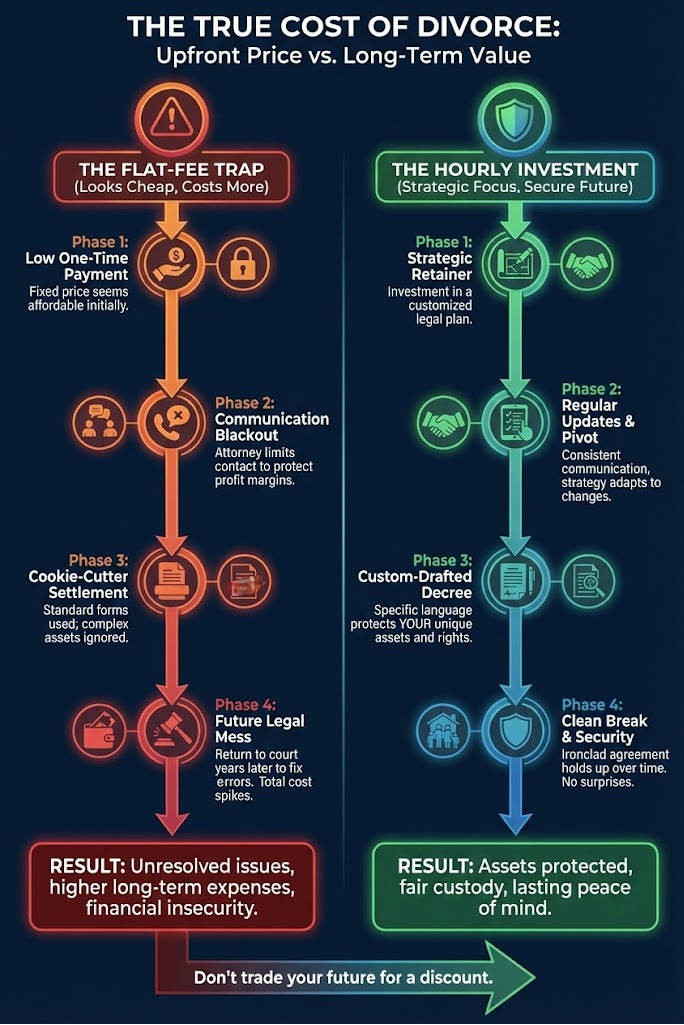
The true cost of a flat-fee divorce often doesn’t appear until months or years after your divorce is final. While you might save money upfront, rushed settlements frequently create expensive problems that require you to go back to court. Many clients end up changing counsel midway through because they’re deeply unhappy with the service they’re receiving, which means paying a second attorney to fix what should have been done correctly the first time.

Poorly drafted agreements create ongoing legal hurdles. Vague language makes enforcement difficult, leading to expensive contempt proceedings. When circumstances change and you need modifications, ambiguities in your original agreement create additional obstacles. Inadequate attention to tax implications and retirement division means future legal costs that could have been avoided.

Perhaps the most significant hidden cost is the impact on your actual outcome. When clients face flat-fee opposing counsel, we consistently see stronger outcomes for our hourly clients because we have the time to thoroughly prepare and advocate effectively. The difference in final asset division, spousal support, or custody arrangements can amount to tens or hundreds of thousands of dollars over time – real money that significantly outweighs any upfront savings. (Image below)

Strategy, Quality, and Advocacy: Why Dedicated Attorney Time Matters

Tailoring Strategy to Your Unique Circumstances

Every divorce is different, and your circumstances require individualized strategic thinking rather than a one-size-fits-all approach. Your financial situation, your children’s needs, your spouse’s behavior, and your goals for the future all combine to create a case that demands customized strategy. At Hastings Shadmehry, we work closely with clients to align strategy with both their circumstances and their financial reality. We understand that not everyone can afford to litigate every issue to the fullest extent possible, but we also know how to prioritize what matters most.

Hourly billing enables strategic advantages that flat-fee arrangements cannot provide:

  • Attorney Expertise: Our attorneys are vetted professionals with deep knowledge of local courts, judges, and opposing counsel
  • Jurisdictional knowledge: Understanding of local court procedures and judges’ preferences and tendencies
  • Ongoing strategy adjustments: Flexibility to pivot as new information emerges or circumstances change
  • Resource allocation: Strategic prioritization of issues that matter most within your budget constraints
  • Relationship leverage: Professional relationships with opposing counsel that facilitate productive negotiation
  • Institutional memory: Long-term understanding of your case that extends beyond the divorce itself

This balancing act requires ongoing communication and flexibility that simply isn’t available in flat-fee arrangements. The flexibility that comes with hourly billing allows your attorney to adapt without worrying whether additional work fits within a predetermined flat fee. This is particularly valuable in family law, where emotions run high and circumstances can change rapidly. The hourly vs flat rate attorney decision directly impacts your attorney’s ability to customize strategy.

Why High-Conflict and High-Asset Divorces Require Hourly Billing

When the stakes are high, whether because of significant assets, complex financial arrangements, or contentious custody disputes, you cannot afford to have an attorney who’s rushing through your case. High-conflict and high-asset divorces demand dedicated attorney time and focus. These cases involve your life, your money, and your children – stakes that are priceless. You need an attorney who will treat your case with the same care and attention they would give their own divorce or custody matter.

High-stakes divorces require intensive work that flat-fee models cannot support:

  • Extensive financial discovery: Working with forensic accountants, business valuation experts, and financial planners
  • Complex asset identification: Ensuring all assets are properly identified, valued, and divided
  • Emergency hearing response: Immediate, strategic action when your spouse engages in harmful behavior
  • Professional coordination: Working with therapists, guardians ad litem, and expert witnesses
  • Comprehensive documentation: Building detailed cases that protect you and your children from harm
  • Trial preparation: Thorough preparation that anticipates arguments and presents compelling evidence

High-asset divorces require careful analysis of complex holdings, and this work takes time and expertise that flat-fee attorneys often lack the bandwidth to provide. High-conflict cases present different challenges when your spouse is uncooperative, combative, or engaging in behaviors that harm your children. Hourly billing gives attorneys the autonomy to strategize thoroughly and pursue the best possible outcome without worrying about whether the time they’re investing fits within a flat-fee profit model.

Addressing Concerns About Hourly Billing Predictability

How Transparent Communication Keeps Costs Under Control

Some clients worry that hourly billing is unpredictable and that costs could spiral out of control. This is a legitimate concern, and it’s one we take seriously at Hastings Shadmehry. The reality is that hourly billing can be highly predictable when your attorney is transparent, experienced, and communicative from the very beginning.

Our approach starts with a thorough onboarding process that allows us to anticipate future developments and costs based on the specific circumstances of your case. We discuss your goals, your spouse’s likely behavior, potential complications, and realistic timelines. This upfront analysis gives us the ability to forecast strategy and expenses with a high degree of accuracy, so you’re not blindsided by unexpected legal bills months into your case.

Throughout your case, you have access to our dedicated billing team who can answer questions about your account without charging you for those conversations. Our billing team is familiar with each case and can provide accurate guidance about where you stand financially and what to expect going forward. This regular communication ensures you always feel informed and in control of costs.

We also have a partner attorney review all bills before they’re sent to eliminate duplication and ensure efficiency. If two attorneys accidentally worked on the same task, we catch it and adjust your bill accordingly. If there’s inefficiency in how something was handled, we address it internally and don’t pass that cost on to you. This level of oversight protects clients from paying for mistakes or redundant work while maintaining the quality and thoroughness that hourly billing makes possible.

What to Look for When Choosing an Hourly vs Flat Rate Attorney

Not all hourly-rate attorneys provide the same level of value, and choosing the right attorney requires more than just comparing rates. You need to evaluate experience, communication style, strategic thinking, and how well the attorney understands your specific circumstances and goals. The right attorney should make you feel confident that your money is being invested wisely in achieving the best possible outcome.

Here’s what to prioritize when choosing an hourly-rate divorce attorney:

  • Experience in family law: Look for attorneys who focus primarily on divorce and custody rather than general practitioners
  • Jurisdictional knowledge: Your attorney should be familiar with local judges, court procedures, and opposing counsel in your area
  • Clear communication style: They should explain legal concepts in ways you understand and respond promptly to your questions
  • Strategic thinking: Look for attorneys who can articulate a clear plan and adjust strategy as circumstances change
  • Transparent billing practices: They should be upfront about costs, provide regular billing updates, and have systems to prevent inefficiency
  • Manageable caseloads: Ask about how many active cases they handle to ensure you’ll receive adequate attention
  • Proven Success in Similar Cases: Look for an attorney who can demonstrate a track record of favorable outcomes in cases that mirror your specific complexities

Experience matters significantly in family law because every case is unique and requires judgment that comes from handling hundreds of similar situations. An experienced attorney can often resolve issues more efficiently than a newer attorney because they know what approaches work with specific judges, what arguments resonate, and what pitfalls to avoid. This efficiency means you’re getting better value for your hourly investment, not just more time.

According to the American Bar Association, experience in family law and jurisdictional knowledge are among the most important factors when choosing divorce representation.

Red Flags to Watch for When Considering a Flat-Fee Attorney

If you’re considering a flat-fee attorney despite the concerns we’ve outlined, there are specific warning signs that should make you reconsider. These red flags often indicate that the attorney’s practice operates on the high-volume, low-quality model that puts clients at a disadvantage. Paying attention to these signs during your initial consultation can save you significant frustration and expense down the road.

Watch for these warning signs when evaluating flat-fee attorneys:

  • Limited experience: Attorneys who are newly licensed or lack extensive family law background
  • Unclear team structure: You don’t know who will actually be handling your case day-to-day
  • Excessive caseloads: The attorney manages numerous cases across multiple counties or admits to handling hundreds of cases
  • Poor responsiveness: Difficulty reaching the attorney or getting timely responses during the consultation process
  • Vague answers about communication: No clear commitment to response times or regular updates
  • Pressure to sign quickly: Pushing you to commit before you’ve had time to consider your options
  • Cookie-cutter approach: Generic advice that doesn’t account for your specific circumstances
  • No discussion of complications: Failure to identify potential roadblocks or challenges in your case

At Hastings Shadmehry, we commit to responding within 24 hours because we understand that family law matters are time-sensitive and emotionally urgent. If an attorney can’t demonstrate that level of responsiveness during the consultation phase when they’re trying to win your business, their responsiveness will only get worse once you’ve signed the agreement. Trust your instincts about whether an attorney genuinely has the bandwidth to give your case the attention it deserves.

When Does a Flat-Fee Divorce Actually Make Sense?

Despite everything we’ve discussed, there are rare situations where a flat-fee divorce might be appropriate. These cases represent roughly 20 percent of divorces, and they share specific characteristics that make them genuinely simple with minimal risk of complications. If your case fits this narrow profile, a flat-fee arrangement might save you money without sacrificing quality.

Flat-fee divorces may work when all of these factors are present:

  • Marriage under two years: Limited time for complex financial entanglement
  • Combined income under six figures: Simpler financial picture with fewer assets
  • No children: Eliminates custody, visitation, and child support complications
  • Minimal assets to divide: Few shared assets mean less negotiation and valuation work
  • Little or no debt: No complicated debt allocation decisions
  • Complete agreement: Both parties are cooperative and aligned on all terms
  • No hidden complications: No concerns about hidden assets, domestic violence, or substance abuse

Even in these situations, you should ensure the attorney will properly address tax implications, debt responsibility, and name changes if applicable.

The challenge is that many couples believe their divorce fits this profile at the beginning, only to discover complications as the process unfolds. If you have any doubt about whether your case is truly this simple, hourly billing provides insurance against the unexpected. The peace of mind and flexibility that comes with hourly representation is worth the potential additional cost for the vast majority of divorces.

Making the Right Choice for Your Divorce

Choosing between flat-fee and hourly billing isn’t just a financial decision. It’s a choice about the quality of representation you’ll receive, the attention your case will get, and ultimately the outcome of one of the most important legal matters you’ll ever face. The people you choose to support you through your divorce will be part of your life and your children’s lives for years to come.

While flat-fee arrangements may appear less expensive on the surface, the hidden costs in reduced attention, rushed preparation, and potentially unfavorable outcomes often far exceed any upfront savings. Your divorce determines your financial security, your relationship with your children, and your ability to move forward into the next chapter of your life. Those stakes demand an attorney who has the time, expertise, and dedication to fight for your best interests without worrying about profit margins.

Choose an attorney you trust, respect, and feel comfortable working with. Look for someone with deep experience in family law who communicates clearly and consistently. Make sure they have manageable caseloads that allow them to give your case the attention it deserves. At Hastings Shadmehry, we believe every client deserves this level of representation, and we’ve built our practice around delivering it through hourly billing that supports quality over volume. The hourly vs flat rate attorney choice isn’t just about cost; it’s about the quality of representation that will shape your future.

Your divorce is too important to leave to chance. Call today and Invest in representation that will protect your interests, advocate for your family, and deliver results you can live with for decades to come.

Posted Under: Divorce