
Life rarely stands still after a divorce. You might change jobs, retire, or face unexpected health challenges. Your former spouse might move in with a new partner or get a significant raise. When these major life events happen, the terms set in your original divorce decree may no longer make sense. This is where alimony modification comes into play.
At Hastings Shadmehry, we understand that a divorce decree feels final. However, Georgia law recognizes that financial realities shift over time. Whether you are paying support or receiving it, understanding when and how you can request a change is vital for your financial future.
The Legal Grounds for Alimony Modification
In Georgia, you cannot simply request a change because you want one. You must meet specific legal standards. Georgia law provides two primary grounds for filing an alimony modification action.
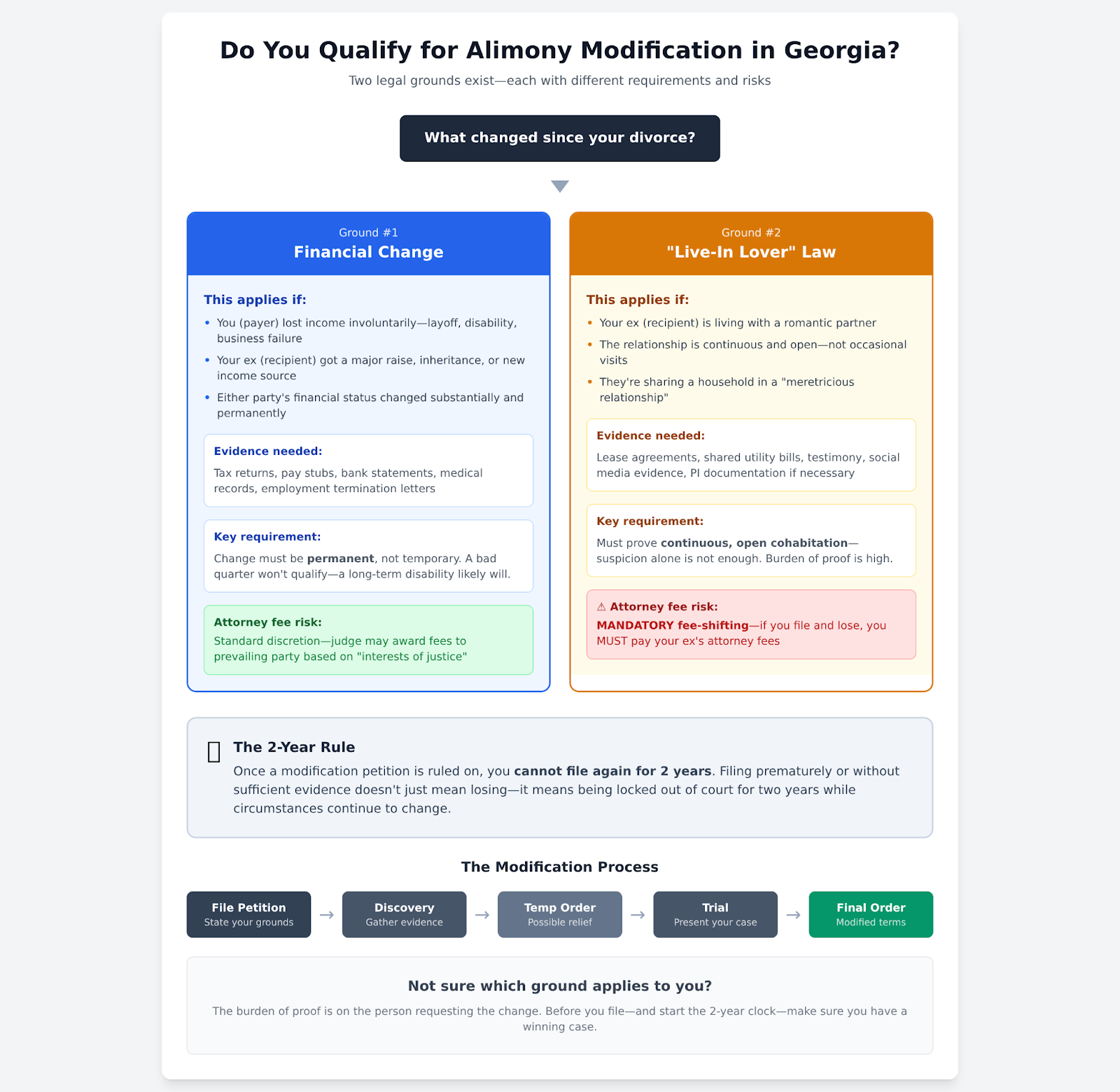
The first ground is a substantial change in income or financial status. This applies to either the person paying or the person receiving support. The second ground involves the receiving spouse voluntarily cohabitating with a third party.
Understanding these distinctions is critical. We often see clients who feel frustrated by their current arrangement. However, frustration alone does not qualify for a modification. You need evidence of a material (substantial) change.
Do You Qualify for Alimony Modification in Georgia?
Before diving deeper into each legal ground, it helps to see how Georgia courts evaluate alimony modification at a high level. The visual guide below walks through the two qualifying paths, the evidence required for each, the risks involved, and how the process unfolds once a petition is filed. This framework mirrors how judges analyze these cases in real life and helps you quickly identify which ground may apply to your situation.
Financial Changes and Alimony Modification
Money is the most common driver for these cases. A modification action based on finances requires proof of a change in the “income and financial status” of either party.
For the paying spouse, this usually involves an involuntary loss of income. Perhaps you were laid off or faced a business downturn. It could also involve a health issue that prevents you from working. The court will look at your ability to pay compared to when the original order was signed.
Conversely, an alimony modification can be appropriate if the receiving spouse’s financial situation improves dramatically. If your former spouse gets a high-paying job or inherits significant wealth, their need for support may decrease.
What Does “Substantial Change” Mean?
Courts look for permanent, not temporary, changes. A bad month at work likely won’t qualify. However, a permanent disability or a long-term reduction in workforce likely would. The court examines various factors to determine if the change is genuine.
These factors often include:
- Changes in net income.
- New fixed debts or obligations.
- Personal living expenses.
Your attorney must “satisfactorily prove” these changes to warrant a revision. This requires detailed financial discovery and clear documentation.
The “Live-In Lover” Law and Alimony Modification
Georgia has a specific statute often called the “Live-In Lover” law. This is a frequent trigger for alimony modification requests.
Under O.C.G.A. § 19-6-19(b), courts may modify support if the receiving spouse voluntarily cohabits with a third party in a “meretricious relationship”. This legal term sounds complex, but the definition is specific. It means dwelling together continuously and openly in a romantic or sexual relationship.
This law exists to ensure fairness. If a former spouse is sharing expenses and living with a romantic partner, their need for financial support often decreases. However, proving this requires more than just suspicion. You must demonstrate that the relationship is continuous and open.
Risks Regarding Cohabitation Claims
We always advise caution with these claims. The burden of proof is high. If you file for alimony modification based on cohabitation and lose, you may be liable for the other party’s attorney fees.
This fee-shifting provision is unique to the cohabitation ground. It is designed to prevent frivolous filings. Because of this risk, we act as both warriors and diplomats. We ensure we have solid evidence before we advise moving forward with a petition based on the “Live-In Lover” statute.
Timeline Rules for Alimony Modification
Timing is everything in family law. You cannot file for modification whenever you choose. There are strict statutory time limits you must respect.
Specifically, once a petition for modification has been ruled on, you cannot file another petition for two years. This two-year rule prevents parties from dragging each other back to court constantly.
This rule emphasizes the importance of strategy. If you file too early or without enough evidence, you might lose. Worse, you would then be barred from filing another
alimony modification petition for two years. We help our clients play chess, not checkers, to ensure the timing serves their long-term goals.

The Process of Filing for Alimony Modification
The process resembles a mini-divorce. It starts by filing a petition in the appropriate court. This petition must clearly state the grounds, whether it is a financial change or cohabitation.
Once filed, the discovery phase begins. This is where we gather the necessary proof. We may request tax returns, bank statements, or employment records. If the claim involves cohabitation, evidence might include lease agreements or proof of shared household expenses.
While this action is pending, the court can grant a temporary modification. This provides relief while waiting for a final trial. This is helpful because contested cases can take months to resolve.
Attorney Fees in Alimony Modification Cases
Many clients worry about the cost of returning to court. It is a valid concern. However, Georgia law allows the judge to award attorney fees to the prevailing party in an alimony modification case.
This discretion is based on the “interests of justice”. The court looks at the outcome of the case and the conduct of the parties. If the other party has been unreasonable or if the modification was clearly necessary, the judge may order them to contribute to your legal costs.
As mentioned earlier, the exception is the cohabitation ground. In those specific cases, paying the respondent’s fees is mandatory if the petitioner fails to prove their case.
Why You Need a Specialist for Alimony Modification
Modifying support is not a do-it-yourself project. The burden of proof is on the person requesting the change. The evidence must be compelling.
At Hastings Shadmehry, we specialize strictly in family law. We understand the nuances of the “meretricious relationship” standard. We know how to analyze complex financial documents to prove a change in income.
Whether you need to reduce payments to survive or want to terminate support due to cohabitation, we can help. We provide the strategic insight necessary to protect your financial interests.
Taking the Next Step
Do not let an outdated court order dictate your financial future. If your circumstances have changed, your support order should reflect that reality.
Contact our team at Hastings Shadmehry today. Let us review your situation and determine if you qualify for an alimony modification. We are ready to guide you through this complex process with clarity and care.
