
Understanding how each model works can help you choose the right approach for your situation. According to the American Bar Association, understanding billing structure is an important part of selecting the right attorney.
Hourly vs. Flat Fee Divorce Attorney
- Hourly attorneys are generally better for complex, contested, or high-asset divorces because they allow flexibility and ongoing strategy.
- Flat-fee attorneys can work well for simple, uncontested divorces where both parties agree on all terms.
- The right choice depends on how likely your case is to change, how much communication you need, and how much risk you are willing to accept.
Key Differences at a Glance
| Feature | Hourly Attorney | Flat-Fee Attorney |
|---|---|---|
| Flexibility | High | Limited |
| Communication | Ongoing and open | Often limited |
| Strategy | Customized and adaptable | Standardized |
| Cost predictability | Moderate | High upfront |
| Best for | Complex or evolving cases | Simple, uncontested cases |
| Risk if case changes | Lower | Higher |
What Is an Hourly Divorce Attorney?
An hourly-rate attorney bills for the time spent working on your case, including negotiations, court appearances, document preparation, and communication.
This structure allows for flexibility. Your attorney can adjust strategy as your case evolves, spend additional time on unexpected issues, and maintain consistent communication without being constrained by a fixed scope.
What Is a Flat-Fee Divorce Attorney?
A flat-fee attorney charges a set price for a defined scope of work. This may apply to a full divorce or only part of the process.
This model offers cost predictability, but it is typically less flexible. The scope of work is often predefined, which can make it more difficult to adapt if the case becomes more complex than expected.
When to Choose an Hourly Attorney
Hourly billing is typically the better option when:
- The divorce is contested
- There are children and custody considerations
- Assets or finances are complex, especially in high-asset divorce cases
- Your spouse is uncooperative or unpredictable
- You want ongoing communication and strategic guidance
- You expect the case may evolve over time
When a Flat-Fee Divorce May Work
Flat-fee arrangements may be appropriate when:
- The divorce is uncontested
- Both parties agree on all terms
- There are no children involved
- Assets and debts are minimal
- There are no signs of conflict or complications
| Billing Type | Pros | Cons |
|---|---|---|
| Hourly Billing |
|
|
| Flat-Fee Billing |
|
|
Andee Hastings Talks Billing Structure Impacts on Your Divorce Case
Time and Attention
Billing structure influences how much time your attorney can dedicate to your case. Hourly models allow for deeper involvement, while flat-fee structures often require efficiency within a defined scope.
Communication
Hourly arrangements typically support ongoing communication. Flat-fee structures may limit contact depending on how the agreement is structured.
Strategy
Hourly billing allows for strategy that evolves with your case. Flat-fee models are often built around predefined processes.
Real-World Scenarios Where the Difference Matters
Many divorces begin with the expectation that they will be simple. In practice, cases often change as new information emerges or circumstances shift.
Common scenarios include:
- A cooperative spouse becomes uncooperative
- Disagreements arise over custody or parenting time
- Financial disclosures reveal unexpected assets or debts
- Retirement accounts or business interests require additional analysis
When this happens, flexibility becomes critical. A billing structure that allows your attorney to adapt can make a meaningful difference in how effectively these issues are handled.
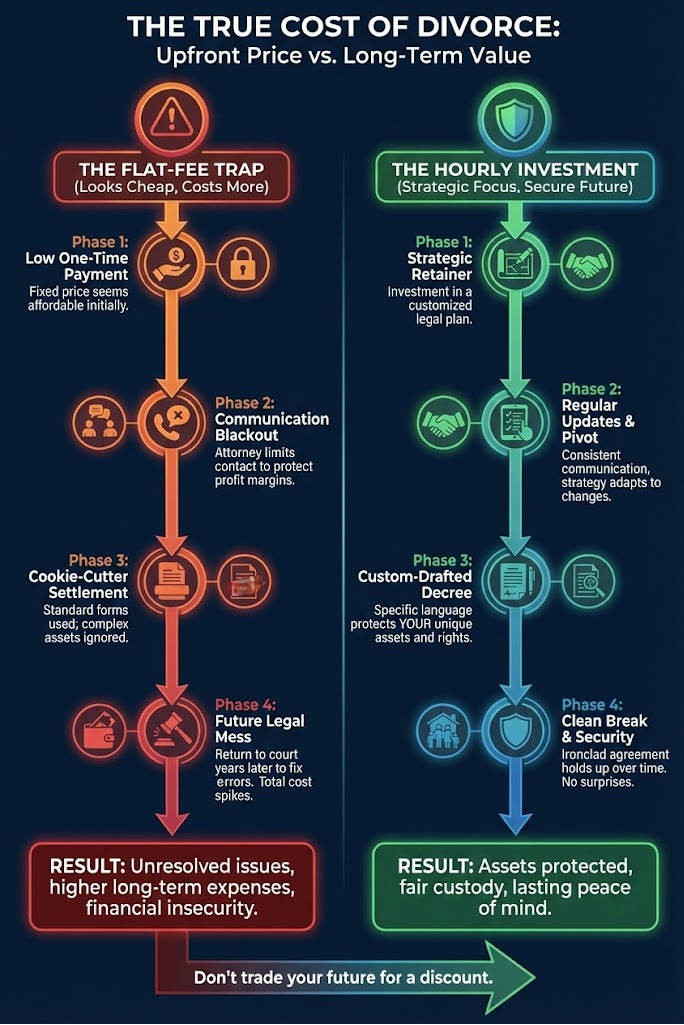
What Happens if Your Divorce Becomes Complicated?
Divorce cases frequently become more complex than anticipated. Some of the most common complications include:
- Hidden or undisclosed assets
- Business ownership or valuation issues
- Complex retirement account division
- High-conflict custody disputes
- Aggressive or uncooperative opposing counsel
These situations often require additional time, strategy, and coordination with outside professionals. A structure that allows for that work can be important to achieving a stable outcome.
The Long-Term Costs That Are Often Overlooked
The total cost of a divorce is not always determined upfront. In some cases, decisions made early in the process can lead to additional legal work later.
For example:
- Agreements that lack clarity may lead to enforcement issues
- Overlooked financial details can create future disputes
- Modifications may be required if circumstances change
While upfront cost is an important consideration, it is also worth evaluating how well the legal work supports long-term stability.
Common FAQ About Divorce Attorney Billing
Is a flat-fee divorce cheaper?
It can be cheaper upfront, but not always overall. If complications arise, additional costs or future legal issues may increase total expenses.
Do hourly attorneys cost more?
Not necessarily. While hourly billing can be higher in complex cases, it often provides more thorough representation and adaptability.
What happens if a flat-fee case becomes complicated?
The attorney may need to charge additional fees, limit services, or continue under a structure that does not fully support the complexity of the case.
Which option is better for custody disputes?
Hourly billing is typically better because custody cases require detailed attention, communication, and ongoing strategy.
Making the Right Choice for Your Divorce
Hourly attorneys provide flexibility, communication, and strategic depth, which makes them a strong choice for many divorces, particularly those involving complexity or conflict.
Flat-fee attorneys can be a good fit for simple, uncontested cases where everything is already agreed upon and unlikely to change.
The most important factor is not just cost, but whether the billing structure supports the needs, risks, and realities of your specific case. If you’re unsure which approach is right for you, you can contact Hastings Shadmehry to discuss your situation and get guidance based on your specific circumstances.
